
Shooters work hard, there is no doubt about it. Some do more hard work than others, but most shooters, at least in their own best capacity, put their best efforts when it comes to training. But what if I told you that even with your best efforts, you are not training 100%?
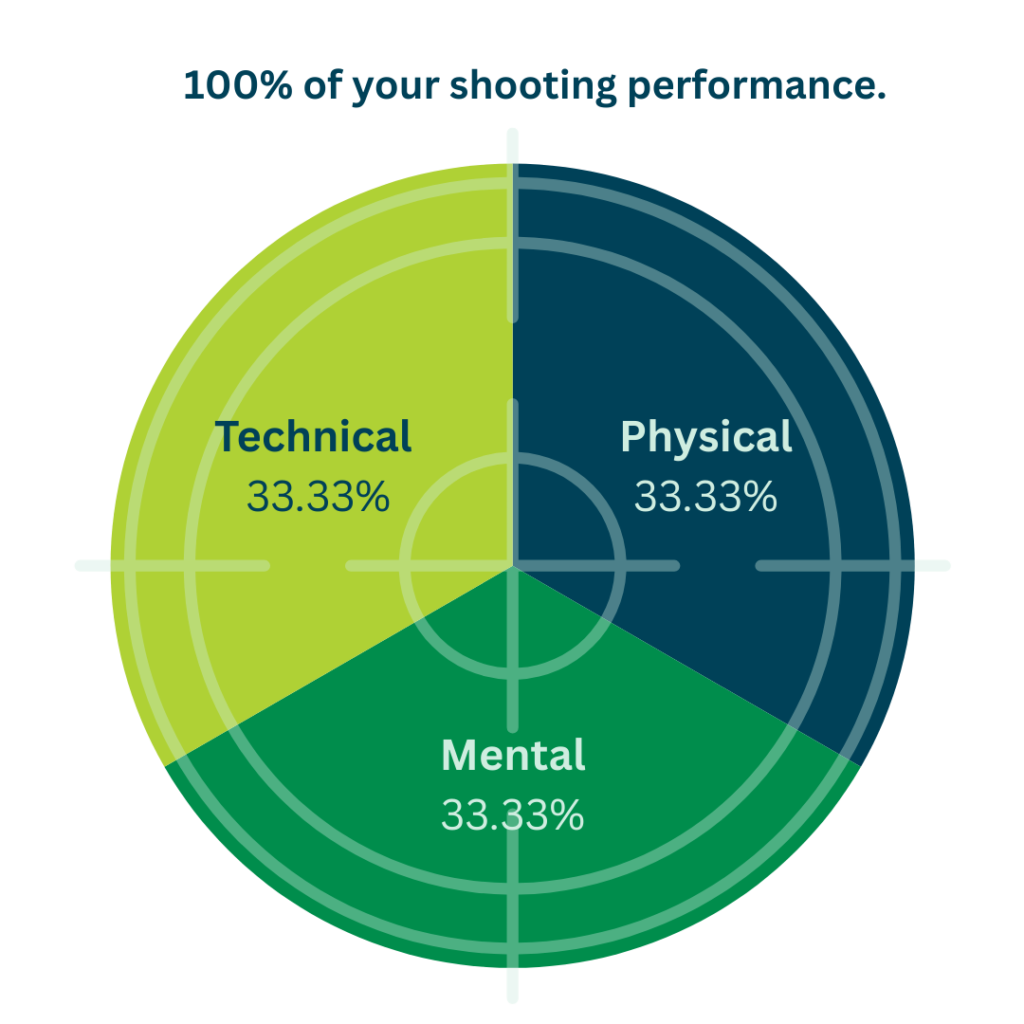
When it comes to training in sports, there are usually three aspects in which athletes can train. You probably guessed it right: physical, technical, and mental.
- Physical training means preparing your body as per the unique demands of that particular sport. It could be endurance for long-distance running or agility for badminton.
- Technical training is refining the specific technique required to play that sport.
- Mental training involves learning psychological skills — both general and sport-specific — to help you develop a mindset that enables peak performance.
To do well in sports, you have to master all three aspects—and shooting is no exception. In fact, shooting is one of the few sports in the world often considered a ‘mental sport’. While that may be up for debate, there are a few good reasons to support this idea:
- Low physical intensity: Compared to most sports, the level of physical intensity is very low. In fact, shooting involves minimal physical movement, especially in precision events.
- High mental endurance: Shooting matches are long. For example, the competition time for air matches is 75 minutes, plus an additional 15 minutes for preparation and sighting. This is far longer than most individual sports, requiring consistent concentration and focus.
- Demand for precision and consistency: Shooting is a precision-based sport and thus requires a high level of technical consistency. In sports like javelin or long jump, one good attempt is enough to get you a podium finish. In fact, you can afford mistakes and make a foul. But in shooting, to even get a spot in finals, you have to execute not 1, 10, or 20 but 60 good shots. And any shooter cannot afford more than 1 or 2 bad shots. This level of technical consistency requires a high level of focus and mental toughness.
So, even if it’s up for debate, one can easily conclude that the mental aspect in shooting is, if not more, then at least equally important. Think of your shooting performance like a tripod stand perfectly balanced with three legs: physical, technical, and mental.
Are You Training All Three?
Let me ask you this — how much time do you spend training each aspect?
If we talk about physical training, most shooters who consider it important spend 45 to 60 minutes training their body in the gym, at the ground, or even at home. For technical training, on average, a shooter spends around 3 hours on the range practicing technique. Now the key question is how much time do you spend? 15 minutes? 10 minutes? Or not at all?
You’re not alone. Most shooters spend less than 15 minutes a day on their mental game. In my opinion, this is the biggest performance gap. Shooters work hard on their physical and technical skills but ignore one of the most important aspects that directly affects performance — the Mental Game. That’s why I say shooters work hard, but only 66.6%.
During competitions, many shooters struggle to deal with pressure and face challenges like low confidence, self-doubt, and lack of focus. After a bad match, shooters often blame their mental aspect yet fail to understand the importance of mental training and face similar challenges even in the next competition.
Why Mental Training is Often Ignored
Based on my experience, here are the main reasons:
- Lack of awareness – Shooters don’t understand or acknowledge its importance.
- Lack of knowledge – Even those who want to improve mentally don’t know what to do.
- Lack of a systematic approach – Shooters try random things without structure, don’t see results, and then quit.
In my 19 years in shooting, I believe lack of a systematic approach is the biggest issue.
When it comes to physical or technical training, shooters usually:
- Assess their current level
- Set clear goals
- Follow a plan
- Stay accountable with a coach or trainer
But when it comes to mental training? That structure is often missing.
I can prove this by asking a simple question: Do you have a written mental training plan? The probable answer would be ‘No’, I know this because I have asked this question to over 1000 shooters (not exaggerating), and more than 99% of the time the answer is no.
How to Begin Mental Training
Shooters often think they need to work with a sports psychologist to work on their mental game, which is true. But to start your mental training journey, you just need to understand the importance, commit to grow, or maybe have a little bit of awareness on areas where you can improve.
While self-reflection and feedback from your coach are very good ways to understand more about your mental game, one very easy way to do that is to take a free mental aspect assessment by visiting the Thriving Athletes website.
You need to answer only around 50 questions, and this free-of-cost assessment will give you a 6-page report of your mental game, highlighting your strengths, areas where you can work, and even certain actionable steps you can take to up your mental game. This is important because knowing and understanding your mental game is the foundation for developing the ‘mindset’ required to excel in shooting.
Begin Today
However you want to assess it, the message I want to convey is simple:
Mental training in a sport like shooting is not optional—it’s mandatory.
You don’t have to wait until you become an elite shooter to start your mental training journey. Sometimes, it’s the mental aspect alone that holds you back from taking a leap in your shooting career. In my opinion, the sooner you start your mental training journey, the better it will be.
That doesn’t mean you have to immediately hire a sports psychologist. Instead, just start by following the right approach.
- Sit down with your coach and set realistic goals for your mental aspect.
- Create a basic plan using the knowledge available online and tools like the free assessment available on the Thriving Athletes website.
- Once you have a written mental plan, start working on it with full commitment—and you’ll soon start seeing results.
Additionally, you can follow Thriving Athletes on Instagram for free content and tips to support your mental training journey—so that you can train not just 66.6%, but a full 100%.
Aman Deep
Founder
Thriving Athletes
Link for free assessment: https://thrivingathletes.in/assessment/
Link for Instagram page: https://www.instagram.com/thriving.athletes/
